You’re mid-set or mid-sprint when it happens: a small leak you weren’t expecting.
If this sounds familiar, you’re far from alone.
Exercise-induced bladder leaks, a form of stress urinary incontinence, affect a significant share of active women, especially after childbirth or during perimenopause and menopause. Many women quietly modify their workouts or skip high-impact rather than deal with the embarrassment.
That, or they stop working out altogether.
It’s a frustrating trade-off, especially for women who’ve spent years building strength and endurance.
But bladder leaks don’t need to stand in the way of you and your healthy routine any longer. Emsella offers a non-invasive way to rebuild pelvic floor strength so bladder leaks during exercise become far less frequent, or stop altogether.
Let’s take a closer look.
What is Emsella, and why does it work for exercise leaks?
Bladder leaks during exercise occur when intra-abdominal pressure exceeds what a weakened pelvic floor can withstand. This is stress urinary incontinence (SUI), and it’s directly tied to pelvic floor muscle strength and coordination.
For many women, the pelvic floor weakens gradually after pregnancy, childbirth, or hormonal shifts during perimenopause, often without any single obvious cause. It’s part of why so many assume leaking is something to live with as they age or stay active.
Emsella uses HIFEM technology to deliver thousands of supramaximal pelvic floor contractions in a single 28-minute session, which is far more than a person could perform voluntarily through Kegel exercises alone.
These contractions retrain and strengthen the muscles that support the bladder and urethra, improving the body’s ability to withstand the pressure spikes that cause leaks during a workout.
Because Emsella works the pelvic floor passively while you sit fully clothed, it’s often the easiest entry point for women who’ve tried Kegels inconsistently or found pelvic floor physical therapy difficult to fit into a busy schedule.

How an Emsella treatment works, step by step
- Consultation. We start by talking through your symptoms. We then review your activity level, exercise goals, and any relevant health history to confirm Emsella for urinary incontinence is the right fit before scheduling your first session.
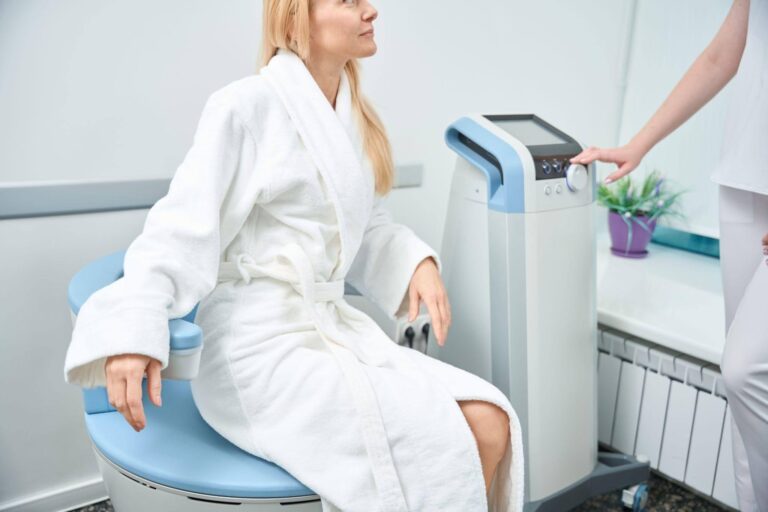
- Get comfortable. Emsella allows you to sit in the chair fully clothed, the same way you’d sit in any chair, instead of needing to undress or put on a gown. Your provider adjusts the settings to your comfort level and answers any last questions before starting.
- Treatment begins. The chair emits HIFEM energy directly into the pelvic floor muscles, producing thousands of supramaximal contractions over about 28 minutes. The intensity typically ramps up gradually so your body can adjust.
- Sensation check. You’ll feel a strong tingling, pulsing, or rhythmic contracting sensation as the muscles engage. It’s similar to an intense, rapid-fire Kegel you couldn’t replicate on your own. Most women find it tolerable and even oddly relaxing; many read, check email, or scroll their phone for the duration.
- Return to activity immediately. There’s no recovery period or restrictions afterward. You go straight back to work, run errands, or even hit the gym the same day.
- Repeat the series. A standard course is six sessions, typically scheduled twice a week over three weeks. Consistency matters here; the contractions build on each other over the course of treatment, which is how the muscle strengthening becomes durable rather than temporary.
Many women notice initial changes partway through the series, with fuller results settling in over the following weeks.
Benefits of Emsella for active women
As a non-invasive option for Emsella for urinary incontinence, this treatment offers several advantages for women dealing with bladder leaks during workouts:
- No surgery, needles, or anesthesia required
- Fully clothed sessions with zero downtime
- Each session delivers thousands of pelvic floor contractions in under 30 minutes
- Supports bladder control during running, weightlifting, jumping, and other high-impact movements
- Complements pelvic floor physical therapy rather than replacing the need for good form and core strength
- FDA-cleared as a non-implanted electrical continence device
Common mistakes to avoid
- Stopping after one or two sessions: Pelvic floor strength builds cumulatively; research supports a full six-session course.
- Expecting an instant fix for severe prolapse. Emsella is most effective for stress, urge, and mixed incontinence, not advanced pelvic organ prolapse. A provider helps determine which applies to you.
- Skipping the consultation. Underlying causes of leaking vary, and a quick evaluation helps confirm Emsella is the right first step.
- Ignoring lifestyle factors. Hydration habits, caffeine intake, and core strength all interact with pelvic floor function and are worth addressing alongside treatment.
- Assuming results are permanent without any maintenance. Many women benefit from an occasional maintenance session down the road, especially after future pregnancies or significant weight changes.
What the research shows
Emsella’s effectiveness for exercise-related bladder leaks is backed by clinical data on HIFEM technology:
- Contraction volume: A single Emsella session delivers roughly 11,200 Kegel-equivalent contractions over about 28 minutes, the mechanical basis for the muscle-strengthening effect.
- Broader research on pelvic floor physical therapy shows meaningful symptom improvement, reinforcing that consistent, targeted pelvic floor work is central to reducing exercise-induced leaks.

Tools and products that support pelvic floor health
Emsella treatment works best as part of a broader pelvic floor care routine. Pairing treatment with the following items also helps:
- Basic core and breathing awareness during workouts
- Moisture-wicking activewear for comfort during the adjustment period
- A bladder diary to track leak frequency
Your provider points you to resources that align with your specific activity level and goals.
Emsella FAQ
Q: How many Emsella treatment sessions will I need to stop bladder leaks during workouts?
A: Most women complete a standard course of six sessions, typically scheduled twice a week over three weeks. Some notice improvement partway through, but the full six-session course is what clinical protocols and research are based on, since pelvic floor strength builds cumulatively with each treatment rather than all at once.
Q: Can I work out on the same day as an Emsella treatment?
A: Yes. Emsella doesn’t involve incisions, needles, or sedation, so there’s no recovery period or activity restriction afterward. You return to normal activity immediately. Many women schedule sessions around their existing routine without needing to plan any downtime at all.
Q: Is Emsella painful?
A: No. Most women feel a strong tingling, pulsing, or rhythmic contracting sensation as the HIFEM energy engages the pelvic floor muscles. It’s similar to an intense Kegel you couldn’t produce on your own.
Q: Will Emsella fix all types of incontinence?
A: Emsella is most effective for stress, urge, and mixed urinary incontinence, which covers the majority of exercise-related leaks. It’s not designed to correct advanced pelvic organ prolapse. A short consultation helps determine which category your symptoms fall into and whether Emsella is the right first step for you.
Q: Does insurance cover Emsella?
Emsella isn’t usually covered because it’s classified as an elective or non-covered treatment. However, coverage varies by insurer and changes over time, so it’s worth asking your provider about.
Why Utah women choose iVee for Emsella
Spanish Fork and the surrounding Utah Valley are home to an active community, including women training for 5Ks along the Spanish Fork River Trail, lifting at local gyms, or chasing kids at soccer practice.
iVee Restorative Care offers Emsella for urinary incontinence in a setting built around whole-body wellness, so pelvic floor health is treated as part of your overall fitness and vitality.
Contact iVee Restorative Care
Bladder leaks during exercise are common, but they aren’t something you have to plan your workouts around indefinitely. Emsella helps rebuild the pelvic floor strength that controls those leaks, backed by real clinical research and a treatment course that fits into a busy schedule.
If exercise-related leaks have been holding you back, book an Emsella consultation with iVee Restorative Care, and take the first step toward moving freely again.